
Key Takeaways:

Configuration drift can reopen attack paths. Changes to firewall rules, inspection settings, or endpoint policies can expose vulnerable systems that were previously protected.

Vulnerability exposure changes even when the CVE doesn't. Security teams need to reassess reachability and existing protections as configurations and exploit intelligence evolve.

Reach connects configuration drift to vulnerability exposure. Reach helps teams identify security control changes, reassess affected attack paths, and prioritize newly exposed vulnerabilities.

Compensating controls help restore protection. Targeted changes to existing security controls can close exposed attack paths and mitigate vulnerabilities while patches are being applied.
Imagine your security team has identified a PHP2Shell vulnerability on an internal application. The team checks who can reach it, confirms that the firewall blocks internet access, and prioritizes more exposed systems for immediate attention.
Then a maintenance change allows internet traffic to reach that same application. The PHP version and CVE are unchanged, but an attacker now has a route that was previously closed. Depending on the protections applied to the new connection, the application could need much more urgent attention.
This is why vulnerability exposure needs to be reassessed as configurations change. Changing security controls can change vulnerability exposure. Firewall rules, inspection policies, and endpoint settings can all affect whether attackers can reach a vulnerable system and what might stop an exploit while teams work toward a patch.
Know which vulnerable services attackers can reach
Reachability starts with a specific question: from where could an attacker connect to the affected service? Reach helps teams examine the network path, the security policies governing it, and the protections that apply when traffic is allowed through.
Consider two equally important PHP services running the same vulnerable software. Service A accepts connections from the internet, and its traffic passes through a policy with an inspection gap. Service B allows connections only from a limited application subnet; internet traffic is denied.
For an attacker originating on the internet, Service A deserves more immediate exposure-reduction attention. Service B still needs a patch, and the team must also examine whether an attacker inside the permitted subnet could reach it. Business impact and the strength of the evidence remain part of the prioritization decision.
Now return to the maintenance change. When a rule starts allowing internet traffic to Service B, the earlier reachability assessment is out of date. The firewall rule that blocked that route was acting as a compensating control. The team needs to evaluate the newly opened path, confirm which defenses apply, and decide whether to remove that access or strengthen protection on the connection.
Three configuration changes that can weaken protection
A change to who can connect and a change to what happens after a connection is allowed can both affect exposure. Here are three examples worth investigating:
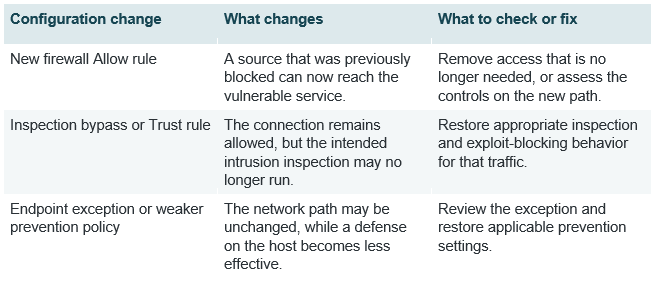
For example, a Trust rule can intentionally allow traffic without additional intrusion inspection. Teams should check whether that behavior is appropriate for the vulnerable service and whether the policy still applies the protections they intend.
New exploit research can also change the picture
Configuration drift is only one reason to revisit an earlier decision. Research can also reveal additional ways to exploit vulnerable software, or show that an existing mitigation covers fewer attack stages than the team initially understood.
The PHP research published in late October is a useful reminder. PHP’s October 23 follow-up described a separate issue involving session-serialization behavior and upload-progress configuration. Tenable’s October 29 analysis also highlighted the importance of the target’s runtime and build when assessing exploitability. Those details can change which systems and defenses deserve closer attention.
Reach’s Exposure Intelligence helps analysts review those developments against the controls in their environment. Alongside the assessed network path, its exploit-chain analysis breaks down techniques and shows which controls are mapped to individual stages. The interface distinguishes Demonstrated, Described, and Hypothetical evidence, so analysts can see the basis for each assessment.
These labels need to be interpreted carefully. A demonstrated research chain is not proof that an exploit was successfully run against a customer’s host. And an unmapped stage does not prove that no defense exists. The useful question is whether the new evidence exposes an attack path that the current controls may not adequately address.
Use Reach to reassess exposure and restore protection
Reach’s configuration drift capabilities help teams investigate changes to firewall rules, inspection settings, and endpoint policies, with context and remediation guidance.
In Exposure Intelligence, analysts can check when an assessment was last updated and select Re-run analysis to request a fresh review. This allows them to reassess the affected path and protections after a relevant configuration change.

Reach then helps teams compare Current Exposure, which reflects the present assessment, with Achievable Exposure, which models the improvement available through proposed control changes. Recommended, Alternative, and Required actions help analysts evaluate the options, dependencies, and scope before approving a change.
A proposed improvement is still a projection. The team needs to implement the change, check the resulting configuration, and reassess the exposure before concluding that protection has been restored.
Keep protection aligned with what is happening now
Firewall rules are modified, temporary exceptions are added, and prevention policies evolve. Each of those changes can affect which vulnerable systems attackers can reach or how well existing controls interrupt exploitation.
Reach helps teams investigate security-control drift, revisit vulnerability exposure, and identify compensating controls that can close or reduce newly exposed attack paths while patching continues. That way, the response priority reflects the defenses and network paths in place today, rather than an earlier assessment.
Keep exploits out until patches go in. And explore Reach’s approach to configuration drift.
Want to learn more about drift and its impact on vulnerability mitigation using compensating controls? Get a demo.
Analyze this article with AI
Prompts open in third-party AI tools.