
Key Takeaways:

Reachability determines exposure. Systems with the same vulnerability can face different levels of risk depending on accessible attack paths and existing protections.

Security configurations determine which protections apply. Firewall rules and inspection settings can leave vulnerable systems exposed even when exploit-blocking controls are available.

Compensating controls can mitigate vulnerabilities. Targeted Cisco FTD policy changes can restrict attack paths or block exploit traffic while patches are pending.

Reach is extending Exposure Intelligence to Cisco FTD. The integration under development will assess reachable vulnerabilities, evaluate existing controls, and recommend specific changes to reduce exposure.
When PHP2Shell vulnerabilities were disclosed, security teams needed to answer two questions quickly: Which affected systems could attackers reach, and what could they do to reduce exposure while patches were being applied?
On November 2, Cisco reported that its SnortML technology had identified and blocked a novel PHP2Shell attempt in customer firewall telemetry within 24 hours of disclosure. That is an encouraging example of what an existing security control can do during the window between disclosure and patching.
Cisco Secure Firewall Threat Defense (FTD) gives teams several ways to apply these protections. The question for each organization is whether its policies apply the right inspection and blocking controls to the traffic that can reach vulnerable systems. Where the connection originates and which policy handles it can change the outcome.
Same vulnerable software. Very different exposure.
Consider two applications running the same affected PHP build. This is an illustrative example of how firewall configuration affects exposure.
The first is a public-facing application. Internet traffic is allowed over HTTPS, but the connection passes through the intended inline intrusion policy. The firewall can read the relevant traffic, and an applicable signature is set to block the exploit. The application remains available to legitimate users while the firewall can interrupt attack traffic covered by that protection.
The second is an employee application. Direct access from the internet is denied, but the application accepts connections from the company’s remote-access subnet. An attacker who compromises an endpoint on that network could reach the application through an allowed connection.
In this example, an earlier Cisco FTD Trust rule is configured to accept that connection. As designed, Trust rules allow matching traffic without subsequent intrusion inspection, even if the connection has already been decrypted. That means the organization’s available PHP2Shell protections are not evaluated on this particular path.
For an attacker starting from the compromised remote-access endpoint, the employee application has the clearer protection gap. That could make it the more urgent mitigation priority, even though it is not directly internet-facing. Both applications still need patches, and teams should weigh business impact, evidence quality, and other potential attacker origins before deciding what to tackle first.
Confirm Cisco’s protections are applied to the path
Cisco Talos lists Snort SIDs 67359, 67360, and 67375 for PHP2Shell-related coverage. SID 67360 addresses the session upload-progress path associated with CVE-2026-109619. These published protections give security teams something concrete to check against the traffic that can reach an affected service.
Start with the rule actually handling the connection. Does it apply the right intrusion policy? Is the relevant signature installed and enabled? Is the firewall operating inline, with an action such as Drop and Generate Events that can stop the triggering session? A rule set to alert can tell you an attack was detected, but it does not provide the same blocking protection.
SnortML needs a separate check. Cisco’s release notes describe expanded HTTP inspection in version 10.1.0 and default enablement in Security Over Connectivity policies. Teams should verify the deployed release and whether the relevant inspector is enabled, without assuming those SnortML-specific requirements also apply to ordinary PHP2Shell signatures.
For HTTPS traffic, visibility is just as important. Security teams need to know where TLS is terminated, whether the firewall decrypts the connection when required, and whether the intrusion engine can read the content needed to detect the exploit. An attached policy alone cannot establish protection if the relevant payload remains encrypted.
Close the exposed path with controls already in place
Return to the employee application. Its current policy permits traffic from the remote-access subnet through a Trust rule, so that connection does not receive intrusion inspection. Depending on whether the access is needed, security teams have two practical options:
- Restrict the connection if it is unnecessary. Narrow the permitted sources or block that path entirely. The vulnerable service then becomes unreachable from the remote-access origin being assessed.
- Inspect and block threats if access is required. Update the policy to use an appropriately scoped Allow rule with intrusion inspection and the relevant blocking protections. Employees can retain required access while the firewall checks for matching malicious requests.
In another environment, the needed change might be attaching the intended intrusion policy, enabling an applicable blocking signature, or correcting the inspection path. The right action depends on which firewall rule applies and what protections that connection actually receives.
Before deployment, review the other devices and services sharing the policy, required content updates, and the effect on legitimate application traffic. Afterward, verify the effective configuration and observed enforcement. The result should be concrete: an unnecessary path is closed, or exploit exposure is reduced on a connection the business needs. These changes address the assessed path and exploit conditions; software remediation is still required.
Bringing Reach’s Exposure Intelligence approach to Cisco FTD
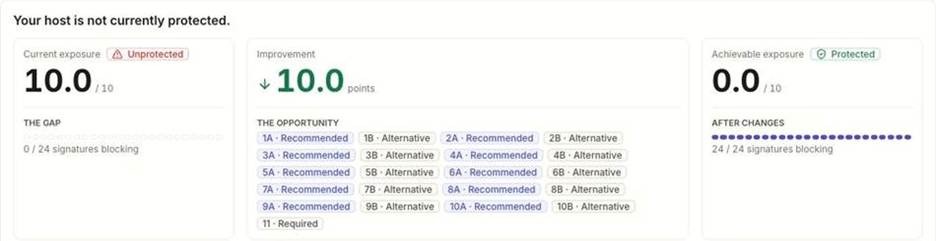
Reach’s existing Exposure Intelligence workflow shows how this analysis can come together. An analyst starts with a CVE and affected host, follows the assessed attacker path and rule order, compares Current Exposure with Achievable Exposure, and reviews recommended control changes. The After Reach changes view previews how the proposed configuration could affect protection before anything is deployed.
We are developing our Cisco FTD integration to bring this approach to Cisco firewall policies and controls. The intended workflow will connect a vulnerable service to the origins that can reach it, explain which protections actually apply, and identify specific configuration changes that could reduce exposure. Cisco-specific analysis remains in development.
Make the next mitigation count
Cisco’s reported block shows what an available defense can do against PHP2Shell. For any individual organization, the next step is to confirm that vulnerable services receive those protections on the paths attackers could actually use. Where a policy intentionally exempts traffic from inspection, a targeted configuration change can help apply Cisco’s existing defenses to the connections that need them.
That is the approach we are extending to Cisco FTD: identify the reachable path, understand the controls applied to it, and recommend the change that can reduce exposure while patching continues.
Keep exploits out until patches go in.
Learn more about Reach’s compensating controls approach and read the Gartner report “How Will Mythos and Frontier AI Models Impact Infrastructure Vulnerability Management?” to see how reachability and compensating controls play a part in modern vulnerability management.
Existing Reach customers can explore the current workflow using our Exposure Intelligence module.
Analyze this article with AI
Prompts open in third-party AI tools.