
Key takeaways
- Firewall misconfigurations create material exposure, with 42% of configuration-related breaches or near misses tied to the firewall.
- AI has raised the requirements for defensive speed, scale, and expertise beyond what manual reviews can provide.
- Network Security Policy Management (NSPM) remains valuable for networking teams responsible for rule administration and change workflows, while continuous assurance enables network security teams to address live rule enforcement, configuration drift, exposure, and remediation.
- Reach gives defenders AI-powered, threat-informed assurance that network security controls remain aligned, enforced, and ready.
Some of the most serious network security weaknesses develop gradually through routine operational changes. Firewall rules are adjusted to support business needs, exceptions remain in place longer than planned, and controls are modified during troubleshooting. Over time, those decisions can push the live environment away from the security posture the organization believes it has.
That drift is especially difficult to see across thousands of rules, dozens of firewalls, and changes made by multiple teams and systems. Risky configurations can disappear into the complexity, leaving broader access than intended, weakened enforcement, or outdated rules still active long after their original purpose has passed.
The consequences are significant. Reach’s 2026 Drift Research Report found that 42% of organizations experiencing a configuration-related breach or near miss cited firewall misconfiguration, making it the most common control associated with those incidents.
Our customer telemetry also shows an average of 13 potentially risky security control changes (configuration drift alerts) per customer each day. In the simplest terms, a drift alert is when Reach notifies the security team that a security control has been changed, shows evidence and context around how the control changed, and offers a path to rapid remediation.
Now, 13 alerts may not feel like a dramatic number in isolation, until you stretch it across the week. That can mean roughly 65 moments when a control moved away from its expected state, each one requiring someone to determine what changed, whether it created exposure, and how quickly it needs to be fixed.
What security controls get changed the most often? Firewall rules.
How does your team quickly detect those weaknesses, correct them, and provide assurance that your organization is protected? Fast-moving AI-fueled adversaries continuously search for those weaknesses. Meanwhile, defenders still rely on periodic review cycles, manual analysis, and tools built for a slower operating environment. Closing that gap requires far greater speed, scale, and specialized intelligence.
AI has changed the operating requirements for defenders
AI gives attackers a force multiplier across three dimensions: speed, scale, and expertise. It accelerates reconnaissance, applies the same techniques across far more targets, and turns sophisticated tradecraft into automation that can run continuously.
Most security teams are working with a very different operating model. A small group may be responsible for 50 to 100 or more firewalls, multiple SASE platforms, WAFs, endpoint firewalls, and hundreds of weekly rule changes. Validating each configuration manually requires time and specialized expertise that few organizations have available at that scale.
The tools and processes supporting those teams were largely designed around human-scale change windows, scheduled reviews, and point-in-time audits. A quarterly rule review may identify some problems, although the resulting snapshot starts aging as soon as the next change lands. Meanwhile, an adversary can continuously probe the environment for those exact weaknesses at breakneck speeds.
Matching that adversary now requires defenders to apply comparable speed, scale, and intelligence to their own controls. But how? And with what tool?
Policy management addresses a different operational need
This is where the role of network security policy management is often misunderstood.
NSPM tools do what they were built to do. They help network and firewall teams administer rules, process change requests, organize policy, document compliance, model topology, and maintain the rulebase. Those capabilities remain useful, particularly for organizations managing complex change workflows.
However, a rule can be approved, documented, and implemented exactly as requested, but still be subject to changes even hours or days later outside of formal change processes. Is the team alerted to this change in real time? What visibility does the team have to these changes when they happen again and again over days, weeks, and months? This can result in a live configuration that is misaligned with the security posture the organization believes it has.
The clearest way to see the distinction is to compare the job each category is built to perform, how it operates, and the outcome it delivers.
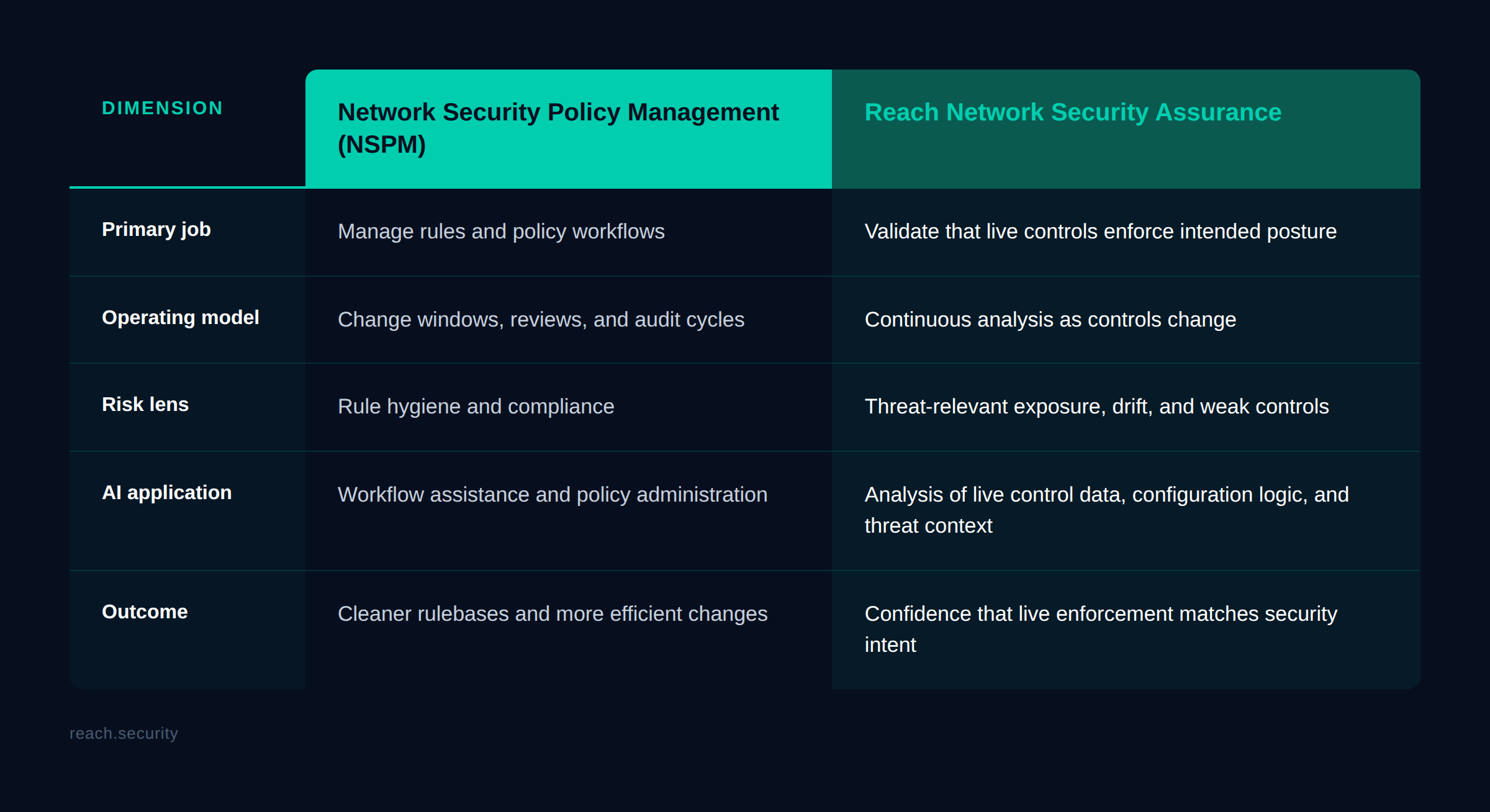
Policy management helps teams understand whether a change followed the proper process. Network Security Assurance determines whether the resulting control is protecting the organization as intended right now.
Let me put the distinction plainly.
Did the change follow the required process? That’s NSPM.
Is the live control actually protecting the business as intended? Across multiple changes per day, do you feel continuously assured that the change strengthened, not weakened, your security posture? That’s Network Security Assurance.
Continuous assurance closes the gap
Reach Network Security Assurance applies cybersecurity domain-specific models to live configuration data, control logic, organizational context, and current threat activity. It continuously validates network security intent, identifies drift and hidden exposure, and prioritizes weaknesses according to the risk they create.
This is what using AI to fight AI looks like in practice. Attackers are applying AI to find weaknesses faster and at greater scale, so defenders need AI-powered tooling that can analyze live controls, understand threat context, surface the weakness, and fix it before an adversary gets there.
Finding a stale or permissive rule provides limited value on its own. Security teams need to understand which device, policy, profile, or access path is affected, why the weakness matters to their environment, and how to correct it safely and rapidly.
Reach ties findings directly to the controls creating the exposure and provides step-by-step remediation guidance. This turns a periodic cleanup exercise into a continuous find-and-fix process spanning firewalls, SASE, and adjacent network security enforcement points.
The outcome is continuous assurance: confidence that network security controls remain aligned with policy, enforce the intended posture, and adapt as quickly as the environment around them.
What security teams need now
Security teams are already telling us where the market needs to go. They need to solve the persistent problem of network security control misconfigurations and drift, and the options available to them today are falling short of the outcome they need.
These teams are facing attackers whose capabilities have been transformed by AI. They operate faster, apply their techniques across more targets, and bring sophisticated intelligence to every stage of an attack. Teams need defensive capabilities built for that same reality.
Meeting them where they are means giving defenders the speed to recognize weaknesses as they appear, the scale to analyze controls across the environment, and the intelligence to understand which gaps matter most. That is how security teams stay ahead of AI-powered attackers and gain confidence that their network security controls are protecting the business as intended.
To learn more about Reach Network Security Assurance, visit https://www.reach.security/solutions/network-security-assurance
Analyze this article with AI
Prompts open in third-party AI tools.