13 Drift Events a Day: See How Much Drift Is Already Happening in Your Environment
Get the report

Every security leader can describe their network security architecture in confident detail: how traffic should flow, where segmentation boundaries sit, which access should never be permitted. What almost none can tell me with certainty is whether their live controls are actually enforcing that design right now, at this very hour.
That gap between what we intend and what is actually running in production is where modern breaches live, and it widens with every change we make.
Network security is not one system but many: firewalls, WAFs, SASE, EDR firewalls, SD-WAN, and a widening set of enforcement points, each governed by rules that change constantly. In many enterprises, a small team is responsible for 50 to 100 or more firewalls and other network security technologies. Each week, hundreds of changes are made by disparate teams, often unbeknownst to the security team. Rules are adjusted to keep applications running, onboard a vendor, or resolve an incident at three in the morning. Most of it is necessary work done in good faith, but all too often there's no reset to baseline after the break-glass change. Every one of those changes can affect how traffic is allowed, blocked, inspected, or routed, leaving the live environment to drift further from security intent each time, without anyone deciding that it should.
So what happens? Risk accumulates quietly in the rulebase. Stale rules stay live, shadowed and unreachable rules obscure true exposure, and any/any rules slip into production and never get removed. Controls drift from baseline or get disabled, and none of it ever announces itself to the security team. And this can lead to breaches. Firewalls are the single most common source of misconfiguration-related breaches, with 42% of security professionals reporting a breach or near miss tied to firewall misconfiguration. EDR and identity control misconfigurations came in 2nd and 3rd place, respectively.
Our customer telemetry from the past year reinforces these findings. Drift is happening daily. The average Reach customer generates 13 drift alerts per day. The most common source of drift is, you guessed it, the firewall. These are actual gaps between how network security controls are configured and how they should be configured based on the organization's real threat profile. The difference is that these drift alerts are instantly actionable and can stop configuration drift in its tracks.
We've seen how teams typically try to catch this. Once a quarter, someone sits down with a spreadsheet of thousands of firewall rules and works through them line by line, sorting out which are stale, which are shadowed, which are overly permissive, and which no longer map to any policy anyone remembers writing. It is exhausting, expensive work, and when it's finished the team still cannot prove that their live rulesets enforce the policies they were built to enforce. The audit was supposed to deliver confidence, but what it actually delivers is a snapshot that's out of date the moment it's done.
What has changed, and why this can no longer be treated as routine hygiene, is that attackers are no longer working on our timeline. AI-powered adversaries can map an environment and find an exploitable misconfiguration in seconds. A review cadence measured in quarters set against an attack capability measured in seconds is not a fair fight. The gap between the two represents months of open exposure that teams simply cannot accept.
Speed and scale is only part of the problem. Insight, context, and intelligence surrounding a control change is equally as important. Even the teams that do keep pace, running every change through a review board that can take hours, still face a question: what will this rule actually do once it is live and how does it affect my risk? A change can pass every process and still widen the attack surface in ways no one intended if you don’t understand its true effect on exposure.
Let me pose a handful of questions that every security team deserves to be able to answer.
What if you did not have to wait for the next review to learn that your posture had drifted, and every change was validated the moment it happened against the intent it was meant to preserve? And not just for firewall rules, but across endpoint security, identity, email, SASE, and more? What if the controls an attacker would actually target were surfaced and prioritized for you, tied directly to the exposure they create rather than buried in a report of ten thousand findings?
What if, instead of periodically cleaning up your network security, you could simply trust that it was continuously correct?
That is a fundamentally different approach than managing a rulebase. Plenty[JD4] of security vendors sell tools that are good at administering rules, documenting compliance, and orchestrating change requests. But administering policy and assuring it are not the same discipline. Knowing how your network is supposed to behave is one thing; knowing in a provable, continuous way that it’s behaving correctly, every hour of every day, is another entirely. That assurance layer is precisely what's been missing.
This is why we built Reach Network Security Assurance – an AI-driven defense for the network security controls that AI attackers target. It's powered by cybersecurity domain-specific language models (DSLMs) and other purpose-built models trained on real-world security data, threat context, and control logic. It identifies misconfigurations, prioritizes the risks attackers are most likely to exploit, guides remediation, and continuously validates that controls remain aligned to policy across NGFW, SASE, and adjacent enforcement points. It delivers value across three areas that map directly to the problem above.
The first is continuously validating network security intent. As environments evolve, controls can drift from intended policy without anyone realizing it, especially when changes originate outside the security team. Reach continuously validates whether controls are configured, prioritized, and enforced as intended, surfacing overly permissive access, ineffective enforcement, policy conflicts, and controls that no longer align with segmentation and least-privilege objectives. Instead of periodic reviews that leave months-long openings for AI-powered attackers to exploit, teams gain ongoing assurance that intent and live enforcement never quietly separate.
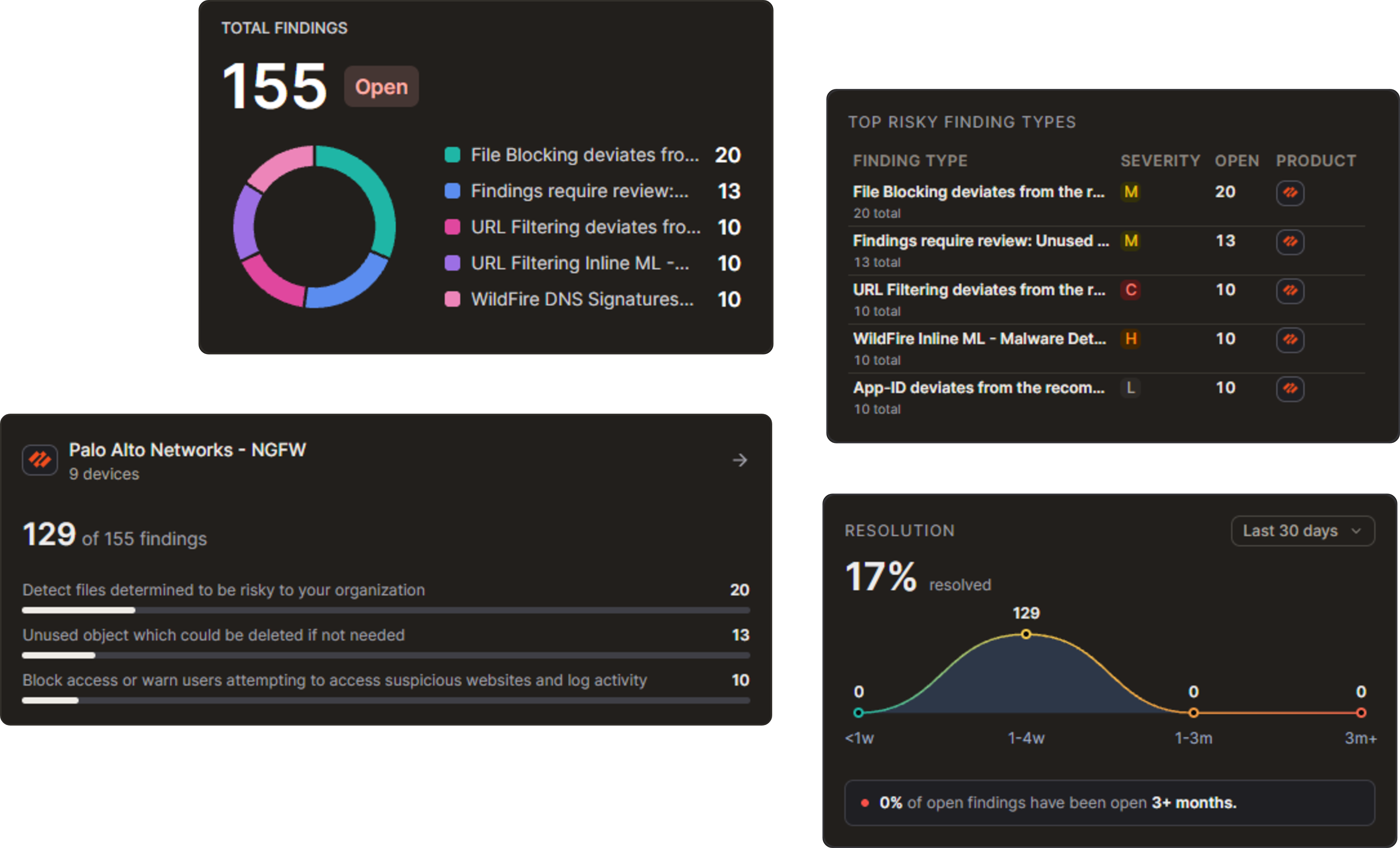
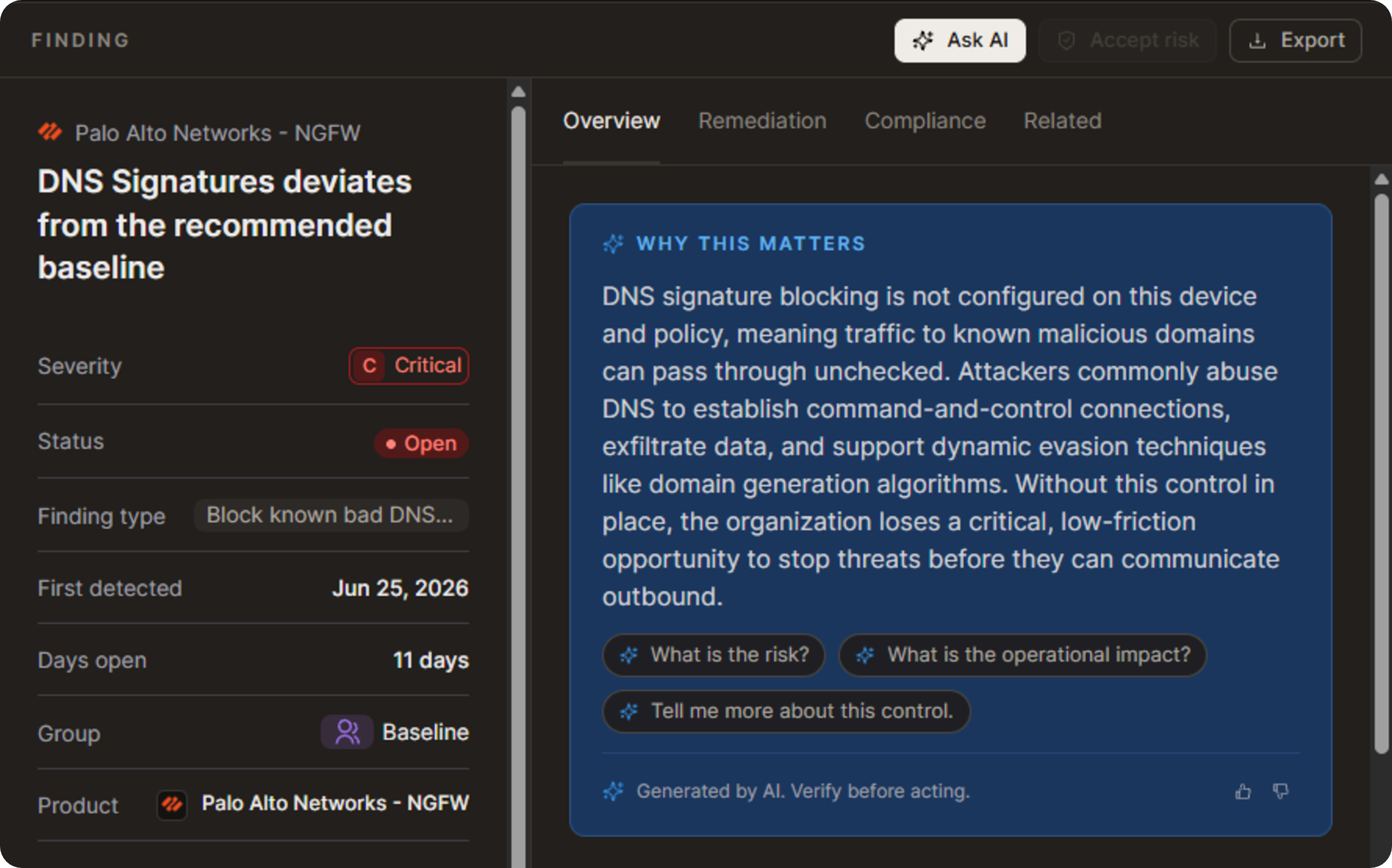
The second is detecting network security drift and hidden exposure. Reach surfaces the rulebase issues that weaken defenses over time, such as unused, shadowed, redundant, disabled, unreachable, and overly permissive rules, using a threat-informed lens that prioritizes what adversaries are actually using, not just what static rule hygiene might flag. It maps every finding to the affected rules, devices, profiles, and policy domains, so teams understand not only what changed, but how that change affects exposure.
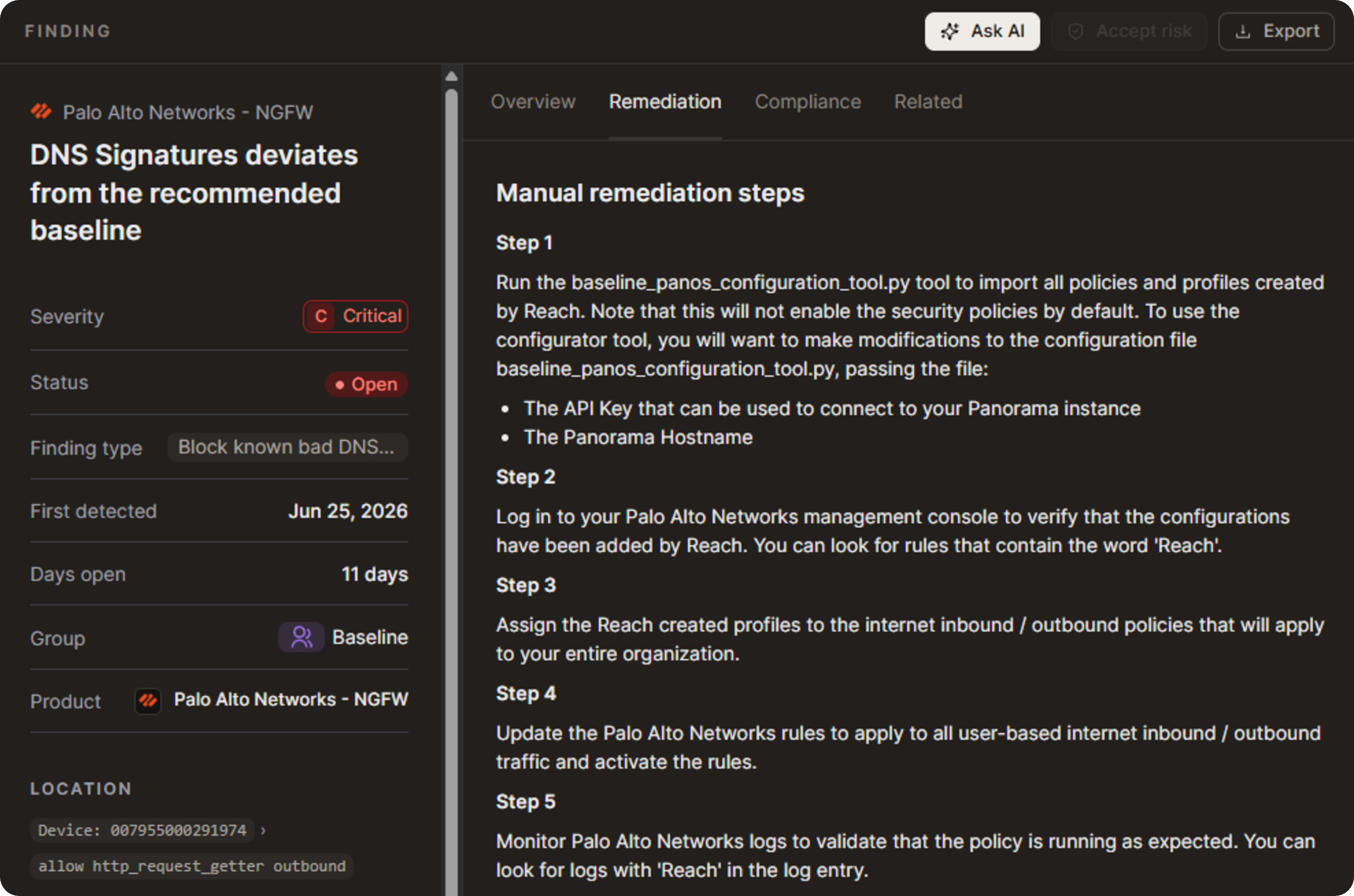
The third is constantly hardening and remediating network security controls. Reach doesn't stop at finding weaknesses. It enables teams to realign controls at operational scale, faster than adversaries can probe the environment. It guides or automates remediation (whichever you prefer) to reduce the attack surface and correct drift before it becomes exploitable. What once required quarterly cleanup projects becomes continuous, AI-driven validation operating in real time.
The result is something network security teams have wanted for a long time: the ability to harden rules without massive manual projects, and the confidence that intent and live enforcement never quietly separate. Your controls will keep changing the way they always have, but you no longer have to find out months later what that change cost you.
As Jonathan Brucato, Director of Security Operations at ECI, told us: "The speed of change in modern network environments and AI-driven attacks have rendered static, point-in-time security reviews ineffective. Clients need to know that their controls are always correctly configured and enforced. Solutions like Reach provide the visibility and agility needed to detect drift and misconfigurations before they can be exploited."
To learn more about Network Security Assurance from Reach, visit the website to watch a demo video, take a product tour, or schedule 30 minutes with us to discuss.
Unlock the full power of your security stack with a free tool rationalization assessment.
Request a Demo

Read-only API key for a security tool of your choice

Create your account and setup the integration

Get results across licensing, control mapping, risk exposure, and posture