
Two PHP servers can carry the same critical CVE and require different immediate work. In an illustrative pair, one accepts requests from an untrusted network through a rule with no effective intrusion prevention. The other is denied on the assessed path. The first needs an immediate mitigation decision. The second needs that restriction preserved while software remediation continues.
Reachability is the starting point for prioritization. Can an attacker reach the vulnerable service from the origin being assessed? If so, do the current controls reduce exposure to the relevant exploit path? What can the team change now?
This sequence is central to the PHP2Shell response. Singapore’s Cyber Security Agency warned on November 3 that attackers are exploiting exposed PAN-OS management interfaces and have reportedly chained PHP2Shell with a separate Linux privilege-escalation flaw.
AI-assisted research helped uncover PHP2Shell, and exploitation attempts were observed before public disclosure. That compressed response window puts a premium on compensating controls that can close an attacker’s route or interrupt an exploit while teams deploy PHP fixes.
Establish reachability to the vulnerable service
Start with the affected asset, service, and attacker origin. Internet reachability, access from a partner network, and access from an already compromised internal segment can create different priorities. A restriction on one path supports a decision about that path; other relevant origins still need assessment.
Reach’s Exposure Intelligence module connects the CVE and selected host with the security products assessed around it. The host view provides platform and endpoint-policy context. The “Where protection stops” graph shows the assessed path through the firewall and effective rule to the host, alongside rules in evaluation order.
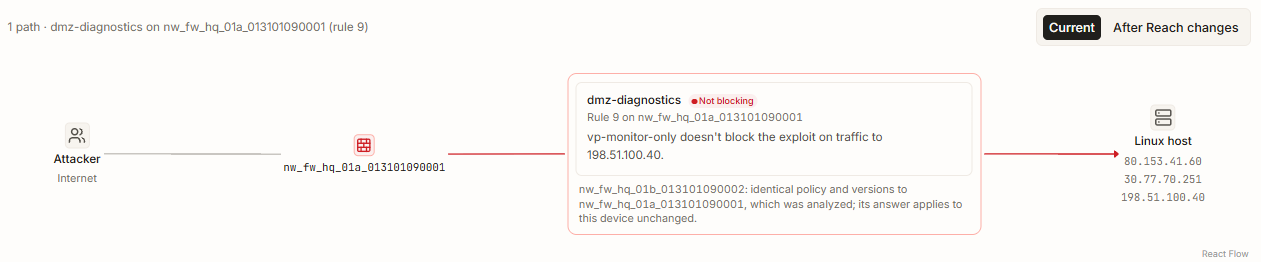
That evidence helps the analyst explain why a service is reachable on the assessed path and where a restriction or inspection gap affects the response. If the path is uncertain, resolving that uncertainty becomes part of the immediate work.
The original PHP2Shell pair is CVE-2026-109618 and CVE-2026-109619. Initial fixed upstream releases are 8.2.35, 8.3.36, 8.4.27, and 8.5.12; distributions and appliances may provide their own fixes. Tenable’s October 29 research further showed why practical exploitation depends on the target’s runtime and build. Prioritization therefore needs both a reachable service and a precise understanding of the affected deployment.
Evaluate exposure on the reachable path
A service can remain reachable for legitimate business use while an applicable control blocks a particular exploit attempt. Assessing exposure means examining what the attacker could do through that path and which controls actually apply.
For an allowed connection, review the effective inspection policy, applicable signatures, blocking actions, exceptions, and payload visibility. At the endpoint, examine the prevention policy governing the affected host and the attack stages it can address. Reach’s Palo Alto Networks and CrowdStrike integrations provide configuration context for those decisions.
Exposure Intelligence presents CVSS severity separately from Current exposure and Achievable exposure. This makes it possible to explain the vulnerability’s severity, the assessed protection today, and the improvement modeled from recommended changes.
Use reachability and remaining control gaps alongside asset criticality to decide immediate work. A reachable service with an unmitigated path warrants attention; a service with applicable protection needs that protection verified and maintained. Both retain their software-remediation requirements.
Turn reachable exposure into a mitigation action
There are two practical ways to reduce the immediate exposure: restrict an unnecessary path or strengthen protection on a path that must remain available. A compensating access rule can deny an attacker’s origin, making the vulnerable service unreachable from that source. When business traffic needs to stay open, an applicable intrusion-prevention control can instead block the exploit attempt on the permitted path.
For Palo Alto Networks, that can mean addressing the effective rule, its Vulnerability Protection profile, or an exception that weakens the intended action. For CrowdStrike, it means checking the affected host’s applicable prevention policy and strengthening a relevant behavioral control. The protection claim should identify the behavior being constrained.
Cisco publishes Snort signatures and has reported a SnortML block of a novel PHP2Shell attempt.Reach’s Cisco FTD integration is in development to connect Cisco configuration evidence with the same reachability, exposure, and mitigation decisions.
The Reach remediation view provides required, recommended, and alternative actions, their configuration scope, and vendor-specific verification guidance. Achievable exposure and the “After Reach changes” view preview the expected improvement. Deployment and reassessment establish the resulting state.
Keep the prioritization decision current
A new allow rule can make a previously restricted service reachable. An inspection exception can weaken protection while its reachability stays the same. Either change can alter the work that deserves attention. Reach’s drift capability provides context for reviewing those configuration changes.
Patching addresses the original flaws. Compensating controls reduce specific paths or consequences while that work proceeds. The priority becomes explainable: which service is reachable, what exposure remains, and which action will reduce it.
Prioritize PHP2Shell based on reachability and act on the exposure you can mitigate with existing controls. Explore Reach’s compensating-control capabilities.
Existing Reach customers can begin in our new Exposure Intelligence module in Reach. Learn more at reach.security
Analyze this article with AI
Prompts open in third-party AI tools.